Mechanical Components
Load-bearing parts, gears, and structural components that need to outperform standard filaments.

When a part must withstand sustained heat, chemical exposure or serious mechanical loading, we move beyond standard filaments. Materials such as PC, Nylon, PEEK and other engineering polymers are sourced and evaluated for each project rather than stocked by default.
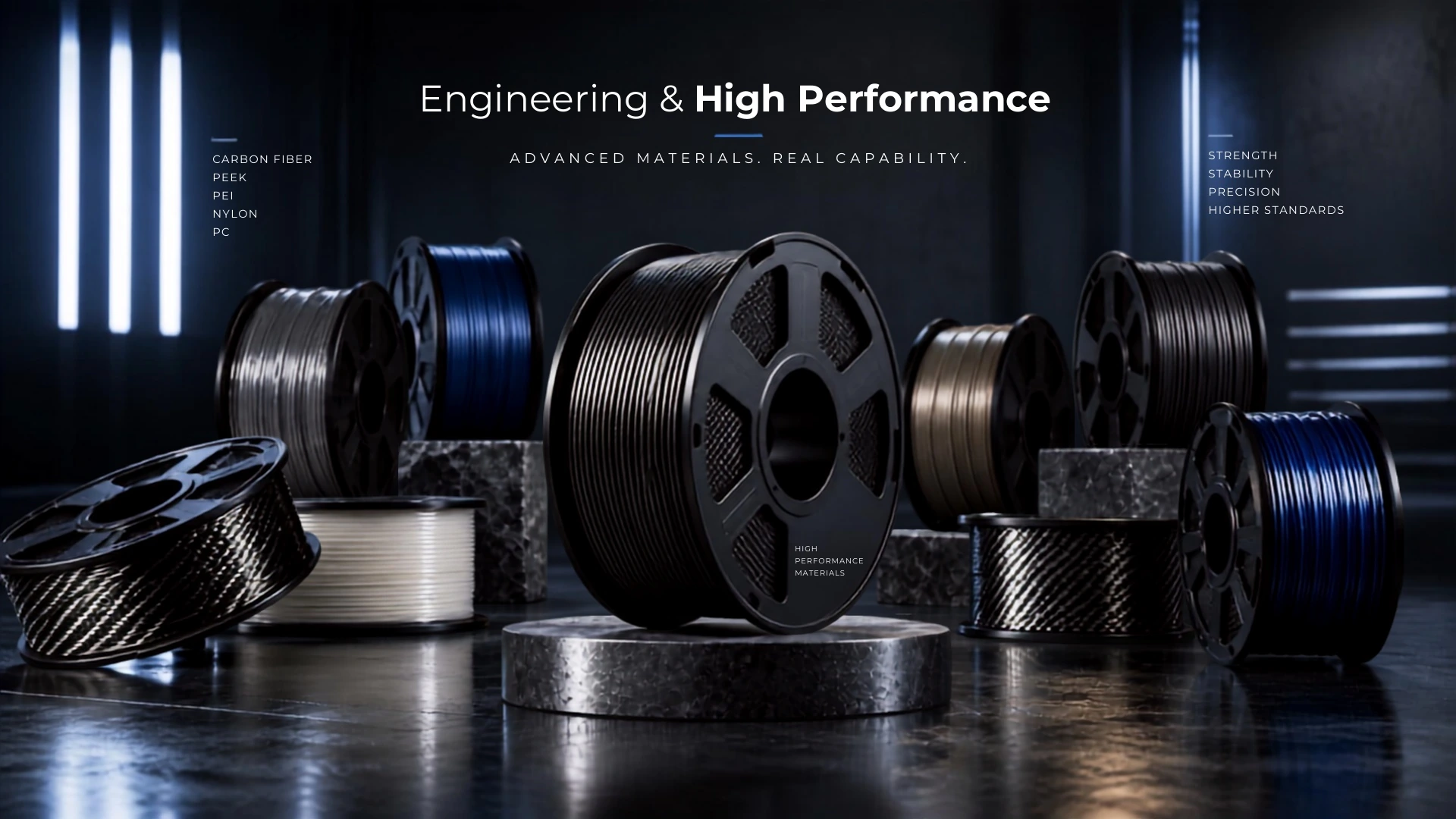
These materials can provide higher strength to weight ratios, greater heat resistance and better wear or chemical resistance than standard filaments. Achieving that performance requires tighter process control and, in some cases, specialised equipment.
Load-bearing parts, gears, and structural components that need to outperform standard filaments.
Components operating near heat sources, where standard filaments would soften or deform.
Fittings and fixtures exposed to solvents, fuels, or other chemicals that would degrade standard plastics.
Bushings, guides, rollers, and moving parts where low friction and long-term wear performance are critical.
This isn't one material but a family, each suited to a different demand: PC and PC-CF for impact strength and clarity, Nylon (PA6/PA12/PA11) and its fibre-filled variants for toughness and wear resistance, PEEK and PEI for sustained high-temperature and chemical environments, and PBT, POM, PP, and PMMA for specific mechanical or electrical properties. These trade easy printing for performance, and typically need tighter process control and, in some cases, specialised equipment to print well. We'll help match the right one to your load, temperature, and chemical requirements rather than defaulting to a single "strong" material.